February 6, 2010 by bobcornelis

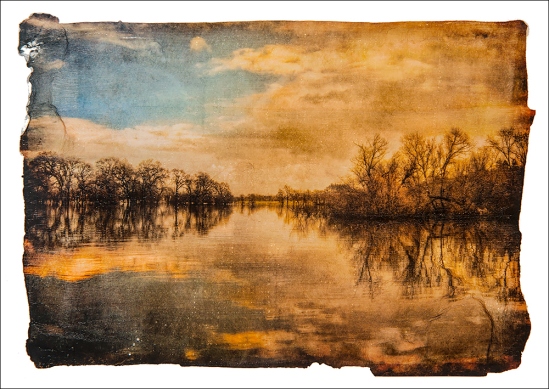
Wabi-Sabi 1, photograph
A funny thing happened this week – one of those whimsical coincidences that can reveal. I read a book that had been recommended by Donna Watson on her wonderful blog Layers. The book is Wabi-Sabi for Artists, Designers, Poets & Philosophers by Leonard Koren. In it I found a phrase the not only resonated with me strongly but was the exact same phrase that had been used by Robert Adams which was the inspiration for my last blog posting. I realized that my previous posting had mysteriously foreshadowed this book and that there was a theme here for me to explore further.
Here is the quote from Koren:
“The simplicity of wabi-sabi is probably best described as the state of grace arrived at by a sober, modest, heartfelt intelligence. The main strategy of this intelligence is economy of means. Pare down the essence but don’t remove the poetry”
There’s that phrase again – economy of means. Why was it haunting me?
First, what is wabi-sabi? I won’t attempt to explain it fully here (Koren’s book does a wonderful job of that) but basically it is a fundamental Japanese aesthetic of beauty. In his introduction Koren describes wabi-sabi:
“Wabi-sabi is a beauty of things imperfect, impermanent, and incomplete. It is a beauty of things modest and humble. It is a beauty of things unconventional.”
I have always been drawn to photographing objects in some state of deterioration. I’d rather shoot an old, decaying building than a new shiny one, a beat up old car than this year’s model, an antique rather than something just made. I never understood what appealed to me in these objects and sometimes felt self-conscious pursuing them.
The concept of wabi-sabi has given me a context within which to consider these subjects. Koren discusses some of the metaphysical, spiritual, moral and emotional foundations of this interesting aesthetic. For example, a metaphysical aspect is “things are devolving toward, or evolving from, nothingness”, while a moral precept is “get rid of all that is unnecessary”. The economy of means phrase refers to the unpretentious simplicity vs. materialistic complexity that is also fundamental to wabi-sabi.
I like the idea that what and how I photograph can cause me to think about the world around me in a more conscious manner. I have a feeling a wabi-sabi series is in my future.


Posted in Aesthetics, creative process, photography | Tagged Aesthetics, B&W photography, japan, photography, wabi-sabi | 5 Comments »
February 3, 2010 by bobcornelis

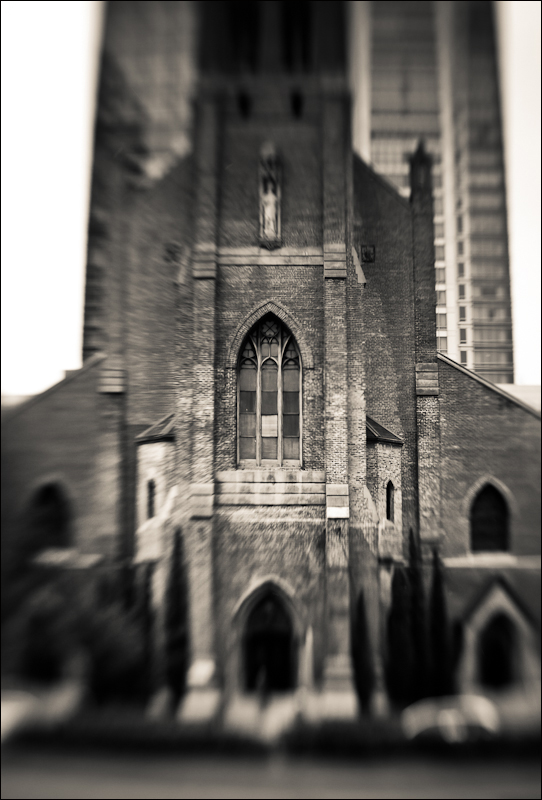
The Avenues, photograph
“Instead their work is usually marked by an economy of means, an apparently everyday sort of relationship with their subject matter.”
- Robert Adams
John Barclay’s blog mini-series on simplicity has gotten me thinking about the the apparent simplicity of much great photography. I use the word apparent because we all know that the appearance of simplicity in most good art belies the difficulty of achieving it.
Sometimes it seems easier to make things more complicated – how’s that for a paradox? In painting, for example, I sometimes had a tendency to put in much more detail than was needed in the work. It was almost as if I was trying to distract the viewer from my lack of design, technique and vision with trivial and unimportant … stuff.
In photography, I can be seduced by crazy lenses, powerful software post-processing and weird lighting and angles. I’m of two minds about this – on the one hand, I love to play with new ideas and approaches and often have felt that “straight” photography was a little boring. On the other hand, I’m aware of the power of a simple, straightforward photograph and how a lot of image trickery can end up feeling gimmicky. I’m sure there is a balance to be pursued in this area.
I like Adams’ phrase “economy of means” – it’s a reminder that you don’t need exotic equipment or technique to create a great picture and that an “everyday sort of relationship” with the subject, while not flashy, can be every bit as potent.


Posted in creative process, photography | Tagged B&W photography, photography | 7 Comments »
January 30, 2010 by bobcornelis

fort point 3, photograph
“There is no progress in art, any more than there is in making love.”
- Man Ray
I found this quote in another essay by Robert Adams in Beauty in Photography called “Making Art New”. He discusses whether art in general has improved over time, which is an interesting question that I’ve never really considered.
It is certainly true that our own individual artmaking can (and hopefully does) improve over time. We acquire more technique and perhaps dive deeper into what inspires our art, making it more personal and meaningful. But can we say in the same way that the quality of art overall is better today than it was a century or two ago?
It’s a hard case to make when we consider some of the art of Michelangelo, Rembrandt, Cezanne, etc. Even in the highly technology laden art of photography, in which the technology has vastly improved to allow us to make new kinds of pictures, can we say that the work of Weston, Cartier-Bresson, or Stieglitz is not at least as good as anything being done today? They used much simpler tools but their results still achieved greatness.
In many ways, we can say we have made progress over past times – medicine, sports, and technology come to mind. But other areas, perhaps more representative of the essential aspects of being human, defy the notion of progress. Methods change, styles come and go, preferences vary, but the basic quality of what is produced in different times doesn’t follow any linear line of progress.
I like this about art – it connects me in a unique way with people from other times. If time travel were possible, we’d have more in common as a result of our art than many other aspects of our lives.


Posted in Aesthetics, creative process, photography | Tagged B&W photography, fort point, photography | 11 Comments »
January 27, 2010 by bobcornelis

rose 1, photograph
“The point of art has never been to make something synonymous with life, however, but to make something of reduced complexity that is nonetheless analogous to life and that can thereby clarify it.”
- Robert Adams
I’ve been working my way through a couple of books of essays by Robert Adams – this quote comes from “Photographing Evil” in Beauty in Photography: Essays in Defense of Traditional Values. He is discussing whether photographers have as much right to “arrange life into a composition” as do painters.
This has been a controversial issue in photography since it’s beginning. There persists a prejudice out there that “arranging life” (a better phrase than the pejorative and dreaded “manipulation”) should not be allowed in much of photography. These days we have many more tools with which we can “arrange life” in our work, especially after the shot has been taken.
Adams’ point above is that any art form is not primarily about exactly representing life. Art, including photography, is always an abstraction of life. Here’s the definition of abstraction from Wikipedia:
Abstraction is the process or result of generalization by reducing the information content of a concept or an observable phenomenon, typically to retain only information which is relevant for a particular purpose.
By reducing information, we keep what is important for our purpose. What to include or exclude is a critical concern of artmaking, perhaps the most important.
John Barclay has an interesting post on his blog about the power of simplicity in photography that makes some interesting points about this. I suspect that the more we can “arrange life” in our work to make it simpler, yet with sufficient analogy to real life, the clearer our intention will be.


Posted in Aesthetics, creative process, photography | Tagged B&W photography, flower, photography, robert adams, rose, simplicity | 8 Comments »
January 24, 2010 by bobcornelis

after the rain, photograph w/ lensbaby macro
“At it’s worst, [contemporary art] offers only imagination without vision, goals without values, individuality without character.”
- Ted Orland
As I read this line in Orland’s The View from the Studio Door I wondered what distinctions he was making here. After all, it seems like a good thing to have goals, use your imagination and express your individuality. On the other hand, vision, values and character does sound better. What’s he after? Here’s my initial simple take, but this is one that I think bears ongoing examination.
Vision unifies imagination.
Values give your goals importance.
Character makes others respect your individuality.
Imagination, goals and individuality allow you to create art that is initially interesting. Vision, values and character allow you to make art that is interesting over time.
I am going to have to contemplate how I can integrate these into my art. It is so easy to just make the art – harder to make it with vision, values and character.


Posted in Aesthetics, creative process, lensbaby, photography | Tagged lensbaby, macro, photography, vision | 15 Comments »
January 21, 2010 by bobcornelis

gesture, photograph
“The work was important because it was good, not because it was different.”
- Ted Orland
I just finished reading Ted Orland’s excellent book, The View from the Studio Door, and particularly enjoyed his discussion of artist communities and how challenging it is to create such a thing in today’s world. The quote above is in the context of how the value of artwork long ago was that it represented and supported the community it came from and was, therefore, good. Today art making is much more disconnected from the community we live in and figuring out how good it is requires a whole different set of criteria.
One of the more popular criteria seems to be if it is different. We are inundated with so many images today, exponentially more than people were a hundred years ago, that it had become harder to do something new and different. So I suppose there is some value in being different, if only because it is so much harder to do so now and the artist had to at least put some effort into achieving that. But there is a tendency to rely too heavily on this single quality as the primary criteria for whether work is good.
I see a lot of work that seems to me to come from a place of just wanting to be different, to shock the viewer with its newness. There is an immediate impact upon seeing such work and grabbing one’s attention is not a bad thing in itself. But there needs to be more, there needs to be a reason to return to the work time and again.
While I haven’t really figured out for myself what qualities in my work will make it compelling to myself and others, I know that difference isn’t what I should focus on. I do try to do things that I haven’t done before (so I don’t get bored) but, if someone else has done similar work, so be it. Mine won’t be exactly the same and there’s just too much work out there to avoid some overlap anyway.
So my search for good hasn’t settled on different…


Posted in Nudes, creative process, photography | Tagged artist community, B&W photography, figure, photography, ted orland | 10 Comments »
January 18, 2010 by bobcornelis

godbeams, photograph
“… feedback is hard to get – except, perhaps, in the form of rejection.”
- Ted Orland
Orland is making this statement in the context of a discussion of art school, which he describes as the one time and place in the life of an artist where they can expect regular feedback on their work.
I personally like feedback and have found it frustrating at times to get any that is of use. People telling me they like or don’t like my work isn’t that helpful – I’d like to know what they like or don’t like and why. Who offers the feedback is a consideration as well – are they an artist or not, how similar is their vision to yours, are they someone you know or a stranger? I actually value feedback from all sources, but I have to filter it through where it’s coming from.
I also have to consider what my objective is in getting feedback – it’s different at different times. Sometimes, to be candid, I probably just want a pat on the back and some encouragement (in which case, I hope they like the work!) and at other times I’m not sure of my direction and need help sorting it out. Then criticism is just as important, if not more important, than positive remarks.
I know artists who don’t really like feedback and I respect that. It can come from a place of confidence in their work or the desire to avoid any outside influence. I suppose sometimes it also comes from a fear of what they might hear.
If you are a teacher yourself, or just have reached a certain “public” stature, it can get more difficult to get good feedback and it might seem to you that you should need it less. How have you dealt with this?
How do you feel about feedback? When do you want it? How do you go about getting it? Has it been helpful to you in the past?
I’m going to be applying to a couple of “portfolio reviews” in the upcoming weeks – if I am accepted, it will be the first time I’ve had any serious review of my work and I’m sure I’ll find it interesting, rewarding, humbling, confusing, etc. Of course, first I have to be accepted, so it’s possible the only feedback I’ll get is rejection!


Posted in creative process, photography | Tagged beach, coast, ocean, photography | 19 Comments »
January 15, 2010 by bobcornelis

fort point 2, photograph
“Audiences and critics care about what is good, artists need to care about what is useful.”
- Ted Orland
You know the old adage that we learn more from our failures than our successes. I suppose this is true in artmaking as well.
While we relish the successful pieces and are so disappointed in the failures, when you look back on your body of work over a long period of time, it is the failures that are more useful to us. It’s an important distinction – the difference between what feels good and what is good for us. Of course, we need both at times. Once in a while we need to feel good about our work so that we don’t give up hope. But our progress is fueled by the ones we don’t so good about.
It is our failures (which always constitute the majority of our work) we spend our time and thought on – how did that happen, how can I do it better, what worked and what didn’t? I use the term “failure” figuratively because, in some sense, there is no such thing as a failure when it comes to art. But we all have plenty of pieces that we choose to just keep to ourselves – you know the ones I’m talking about. It’s good to hang onto these and spend some time with them periodically. It would be fascinating if some well known, talented artist had a show of their failures, with a brief description of what lesson each taught them.
The trick to making these pieces useful is to learn how to listen to what they have to tell us. This is not as easy as it sounds. Knowing how to learn from our own work takes patience, a fierce resolve and the understanding that feeling good is not the only goal an artist has.


Posted in Aesthetics, creative process, photography | Tagged art, B&W photography, failure, fort point, photography, success | 2 Comments »
January 12, 2010 by bobcornelis

fort point 1, photograph
“If, however, teaching photography means bringing students to find their own individual photographic visions, I think it is impossible. We would be pretending to offer the students, in William Stafford’s phrase, ‘a wilderness with a map’.”
- Brooks Jensen
Teaching photography, or art in general, is challenging and many, if not most, good artists are not good teachers (most people are not good teachers). Teaching art is particularly hard because there is this “personal vision” thing at which artists eventually aim their focus. It’s what makes it my art, and separates it from the art I made while still learning my craft. Many of us won’t feel successful until we’ve connected with it.
Personal vision is extremely elusive. Our initial experience with it tends to arise from a growing dissatisfaction with our work, so we are introduced to it by it’s absence. We often look to teachers for help, those who we believe have discovered their own personal vision. Sometimes we “adopt” their vision, sometimes we want to hear the steps they took to get there and sometimes we just want encouragement on our own journey.
There are several problems we face in getting help from teachers to discover our vision. At best, they have discovered their vision, not yours. Your vision is a product of all the unique experiences and qualities that define you and thus cannot be truly understood, much less taught, by another. And I bet you would be surprised how many of these teachers, if pressed, would admit to not even understanding their own vision. It’s not clear that personal vision is something that, once developed, is retained – I think it evolves as you do, since it is an expression of your thoughts and emotions, which change over time. So there will be periods where you feel in synch with your vision and times when you don’t – it’s a moving target, one which needs to be continually reacquired.
I love the metaphor used by Stafford above – artistic vision is a wilderness and there is no map. It takes courage to wander into it without concrete guidance but there is no other way to embark on the journey.
Teaching art can serve an important purpose. There are definitely skills to learn, techniques and craft to develop. You can save enormous time by learning these things from others. And a good teacher will provide the support and environment that makes your travels through the wilderness less intimidating. They might even accompany you on the journey.
But only you can chart the right path through the wilderness…
Posted in Aesthetics, creative process, hdr, photography | Tagged art, fort point, HDR photography, photography, teaching | 9 Comments »
January 9, 2010 by bobcornelis

you go first, photograph
“I have been urged … to write about my paintings… Why? Haven’t I, in a way, painted them?”
- Charles Demuth
This quote is referenced in a wonderful short essay (Writing) by Robert Adams in his book, Why People Photograph. Adams discusses the topic of artists writing about their own work and makes some interesting observations.
As you might expect form the quote, Adams concludes that photographers (and artists in general) are not good at describing their own work and, in fact, do not want to do it anyway. Artists feel their work should speak for itself, be self-sufficient, and having to talk about it admits a modicum of artistic failure. Too much talk also risks the kind of over-analysis that can get in the way of spontaneous creativity. Since photography by its nature is often more representational and less subjective than painting, the public often feels more need to have the photographer describe their work to get at what they were feeling inside.
I know as one who has had to try to write about specific work in the past, it is extremely difficult and makes me feel very self-conscious. I usually feel that I’m tacking on these descriptions after the fact and that they were not really present at the time of artmaking or prior to it. Much of what I read from critics or other artists about their work gives me the same feeling.
What value is this post-analysis? Is there real benefit to oneself or others in attempting to truly describe one’s work from a sincere perspective. Can it provide insight into the creative process that allows others a deeper appreciation of your work? Can this effort force you to contemplate your own work in a way that might prove beneficial?
Ultimately I think that words are inherently insufficient to describe what is going on in the art as well as is the art itself. Words themselves are an art form. I’ve seen wonderful art which combines painting or photography with words, where both are equal partners in the product. Neither tries to explain the other. Can you imagine someone trying to explain a symphony by painting it? My wife, Susan’s, art journals are a great example of the power of combining words with visual art, rather than trying to use one to explain the other. I think it is useful to contemplate our own work but the effort to translate those ruminations into words useful to others seems doomed to failure.
Adams recommends that if we want to understand an artists work, the best strategy may be to look at the work of other artists that they like. The reflected light from that art may illuminate their work more than any direct explanation could possibly do.
By the way, I’d also like to announce the launch of my new website, www.bobcornelis.com, which replaces my old site (cornelisarts.com). I recommend taking advantage of the full screen mode in the galleries to see the best view of the work. Enjoy!


Posted in creative process, painting process, photography | Tagged photography, robert adams, susan cornelis, writing | 8 Comments »
Older Posts »